Available For Emergencies 24 Hours A Day, 7 Days A Week

Mon-Fri: 07:30am - 4:30pm
Sat-Sun: Closed

Service Plans
View Your Coverage Types

(215) 269-6590
6901 Bristol Pike, Levittown, PA 19057


Furnace Repair or Replacement,
How Do You Know Which One Your Home Needs?
- November 24, 2026
- Blog
- Robaire Company
Contact Information
Call
215-269-6590
Address
6901 Bristol Pike, Levittown, PA
About
We offer 24/7 emergency HVAC service to all of our customers. You can always count on the experts at Robaire Company to get to you fast and get the job done right the first time. We use state-of-the-art diagnostic equipment to find the source of your heating and air conditioning problems and fix them fast.

Finance Your Project


If your furnace is under 15 years old and the repair cost is reasonable, repair is usually the smarter choice. If it’s 15 years or older, the repair costs more than half of a new furnace, or you’re facing safety concerns like carbon monoxide risk, replacement typically saves you money and worry in the long run. A professional inspection from Robaire Company can confirm which path fits your home.
A furnace breakdown has a way of showing up at the worst possible moment, usually on the coldest night of the year, when your family needs heat the most. Beyond the discomfort, there’s the financial stress of wondering whether a repair bill is worth paying or whether you should be putting that money toward a brand new system instead.
At Robaire Company, we’ve spent years helping homeowners work through exactly this dilemma. We understand that furnace problems rarely come with an obvious answer, and the wrong choice can mean wasted money, continued discomfort, or even safety risks. Our technicians are trained to look past the symptoms and diagnose the real condition of your system, so you can make a confident, informed decision.
Below we’ll walk through the key factors that separate a furnace worth repairing from one that’s ready for retirement. We’ll cover the warning signs to watch for, the numbers that matter most, and why a professional assessment is the single best step you can take before spending a dollar.
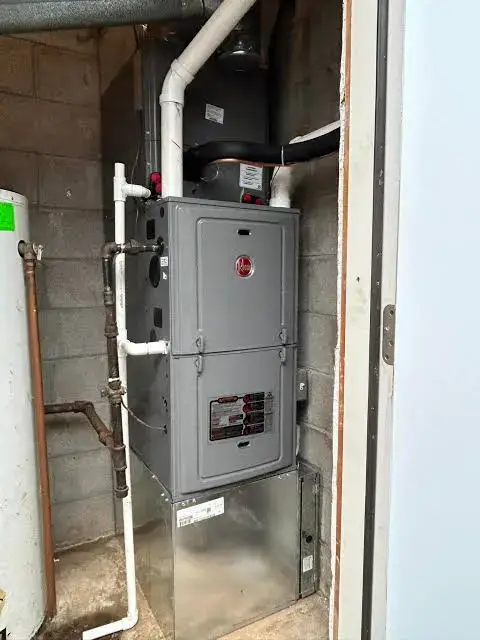
What are the signs your furnace just needs a repair?
Not every furnace problem means it’s time to replace the whole system. In many cases, a repair can restore your furnace to full working order for a fraction of the cost of a new unit. Here are the signs that typically point toward repair rather than replacement.
Is your furnace making unusual noises?
Banging, rattling, squealing, or grinding sounds often point to a specific mechanical issue, such as a loose belt, a failing blower motor, or a cracked heat exchanger. These problems are frequently repairable, especially if caught early, before they cause damage to other components.
Is your home heating unevenly?
If some rooms feel warm while others stay chilly, the issue could be as simple as a blocked vent, a failing blower, or a thermostat that needs recalibrating. These are common, fixable problems that don’t necessarily signal the end of your furnace’s life.
Have your energy bills crept up with no clear cause?
A sudden, unexplained rise in heating costs often means your furnace is working harder than it should, usually due to a dirty filter, a failing component, or a buildup of debris. A tune up or targeted repair can often bring efficiency back in line.
Is your pilot light acting up or is your furnace cycling on and off too often?
Frequent short cycling or a pilot light that won’t stay lit can stem from a faulty thermocouple, a dirty flame sensor, or a clogged filter. These are typically inexpensive fixes that a technician can resolve in a single visit.
Is your furnace still fairly young?
Generally speaking, a furnace under 15 years old with a repairable issue is a strong candidate for repair rather than replacement. Furnace age is one of the clearest indicators of whether repair or replacement makes more financial sense.
What are the signs your furnace actually needs to be replaced?
While many furnace issues are fixable, some situations point clearly toward replacement. Knowing these signs can save you from pouring money into a system that’s nearing the end of its useful life.
Is your furnace 15 years or older and experiencing problems?
Most gas furnaces are built to last between 15 and 20 years. Once a furnace crosses that 15 year mark and starts developing issues, the odds of further breakdowns increase significantly, and replacement often becomes the more practical choice.
Does the repair cost more than half the price of a new furnace?
This is often called the 50 percent rule. If a single repair would cost more than 50 percent of what a new furnace would cost, replacement is generally the better financial decision. Even more specifically, we recommend replacement when a furnace is 15 years or older and the repair cost reaches that 50 percent threshold.
Do you see rust or corrosion on the unit?
Persistent rust or corrosion, especially around the heat exchanger or burner assembly, is a sign of deeper structural problems that repairs typically can’t resolve. Corrosion can also point to safety concerns, which brings us to our next sign.
Are you concerned about carbon monoxide or other safety issues?
Carbon monoxide leaks are a serious safety risk, and any suspicion of a leak should be treated as an emergency. If your carbon monoxide detector alarms or you notice symptoms like headaches, dizziness, or nausea while your furnace is running, turn off the unit immediately, leave the area if needed, and contact your gas utility or emergency services right away. A furnace with a history of safety issues is rarely worth continued investment.
Does your system struggle to maintain a consistent temperature even after repairs?
If you’ve had your furnace repaired multiple times and it still can’t keep your home at a steady, comfortable temperature, that’s a strong signal the system is simply worn out. Furnaces in the 15 to 20 year range with a history of repeated breakdowns are often better replaced than repaired again.
How do repair costs compare to the investment in a new furnace?
The financial side of this decision matters just as much as the technical side. A repair might solve your immediate problem, but it’s worth weighing that cost against the long term value of a new system.
Newer furnaces are generally built with higher efficiency ratings, measured by AFUE, or Annual Fuel Utilization Efficiency. A higher AFUE rating means more of the fuel your furnace uses actually converts into heat for your home, rather than being lost as waste. Over time, this efficiency can translate into lower monthly utility bills, though the exact savings depend on your specific home, usage patterns, and current system. One of our technicians can walk you through what that might look like for your household.
It’s also worth checking for rebates in your area. ENERGY STAR offers a Rebate Finder tool that lets you search by ZIP code for utility, state, and local rebate programs that may apply to a new furnace installation. Financing options are also commonly available, which can make the upfront cost of replacement more manageable.
Why does a professional assessment matter so much in this decision?
It’s tempting to try to diagnose a furnace problem yourself, especially when you’re trying to save money. But furnace systems are complex, and issues that look minor on the surface can sometimes point to much larger problems underneath.
A DIY assessment can easily miss warning signs like early stage heat exchanger cracks, electrical issues, or ventilation problems that aren’t visible without specialized tools. These are exactly the kinds of issues that, left unchecked, can turn into safety hazards or expensive emergency repairs down the road.
At Robaire Company, our technicians perform thorough inspections that look at your furnace’s overall condition, age, efficiency, and repair history before making a recommendation. We believe in giving homeowners honest, straightforward guidance, not a sales pitch. If repair is the right call, we’ll tell you. If replacement makes more sense for your budget and safety, we’ll explain exactly why.
Ready to find out whether your furnace needs repair or replacement?
If you’re on the fence about your furnace, the best next step is a professional evaluation. At Robaire Company we offer a free furnace evaluation to help you understand exactly what’s going on with your system and what your options are. Our technicians will walk you through our findings in plain language, answer your questions, and help you decide on a path forward that fits your home and your budget.
Reach out to our team today to schedule your free furnace evaluation. Whether your system needs a quick repair or it’s time to consider something new, we’re here to help you make the right call with confidence.
Making the right call for your home
Deciding between furnace repair and replacement comes down to a handful of key factors, the age of your system, the cost of the repair relative to a new unit, the presence of safety concerns, and how consistently your furnace has been able to keep your home warm. None of these factors exist in isolation, which is why a professional evaluation matters so much.
At Robaire Company, we’re committed to helping homeowners make informed decisions about their heating systems, backed by honest assessments and clear explanations. Whatever your furnace needs, our team is ready to help you find the best outcome for your home and your budget.

Frequently Asked Questions
How much does furnace repair typically cost compared to replacement?
Repair costs vary widely depending on the issue, but as a general guideline, if a repair would cost more than 50 percent of what a new furnace costs, replacement is usually the more cost effective choice over time.
How long does a gas furnace typically last?
Most gas furnaces last between 15 and 20 years with proper maintenance. Once a furnace passes the 15 year mark and starts needing frequent repairs, replacement often becomes the more practical option.
Is it safe to keep using a furnace if I suspect a carbon monoxide issue?
No. If you suspect a carbon monoxide leak, turn off your furnace immediately, leave the area if symptoms are present, and contact your gas utility or emergency services right away. Do not attempt to diagnose or repair the issue yourself.
Are there rebates or financing options available for a new furnace?
Rebates vary by location. ENERGY STAR offers a Rebate Finder tool where you can search for available utility, state, and local rebates by ZIP code. Many HVAC companies, including Robaire Company, can also discuss financing options to help make replacement more affordable.
What should I do if I'm not sure whether to repair or replace my furnace?
The best step is to schedule a professional evaluation. Robaire Company offers a free furnace evaluation where our technicians inspect your system and provide an honest recommendation based on its age, condition, and repair history.
Schedule an Appointment
Contact Robaire Company, Inc.
We offer 24/7 Emergency Service to all of our customers. We also understand the importance of being safe and comfortable in your home. Robaire Company, Inc. is a certified Rheem ProPartner. We are licensed and insured in PA, NJ and DE. Please ask for references. Your comfort… It’s that important!