Available For Emergencies 24 Hours A Day, 7 Days A Week

Mon-Fri: 07:30am - 4:30pm
Sat-Sun: Closed

Service Plans
View Your Coverage Types

(215) 269-6590
6901 Bristol Pike, Levittown, PA 19057


5 Signs Your HVAC System Needs Service
- July 7, 2026
- Blog
- Robaire Company
Contact Information
Call
215-269-6590
Address
6901 Bristol Pike, Levittown, PA
About
We offer 24/7 emergency service to all of our customers. You can always count on the experts at Robaire Company to get to you fast and get the job done right the first time. We use state-of-the-art diagnostic equipment to find the source of your heating and air conditioning problems and fix them fast.

Finance Your Project


Your HVAC system may need professional service if you notice weak airflow, uneven temperatures, strange odors, unusually high energy bills, or short cycling. Catching these signs early prevents costly breakdowns, improves comfort, and extends the life of your system.
Most people don’t think about their HVAC system until something goes wrong. That’s understandable, when it’s working, it blends into the background. But the warning signs of a struggling system usually show up long before a full breakdown, and ignoring them costs more than fixing them.
At Robaire Company, we’ve helped homeowners and businesses diagnose and repair HVAC problems for years. We’ve seen what happens when small issues get overlooked, and we’ve seen what a well-maintained system can do for comfort and energy costs. Here are five signs your HVAC system may need professional attention and what each one actually means.
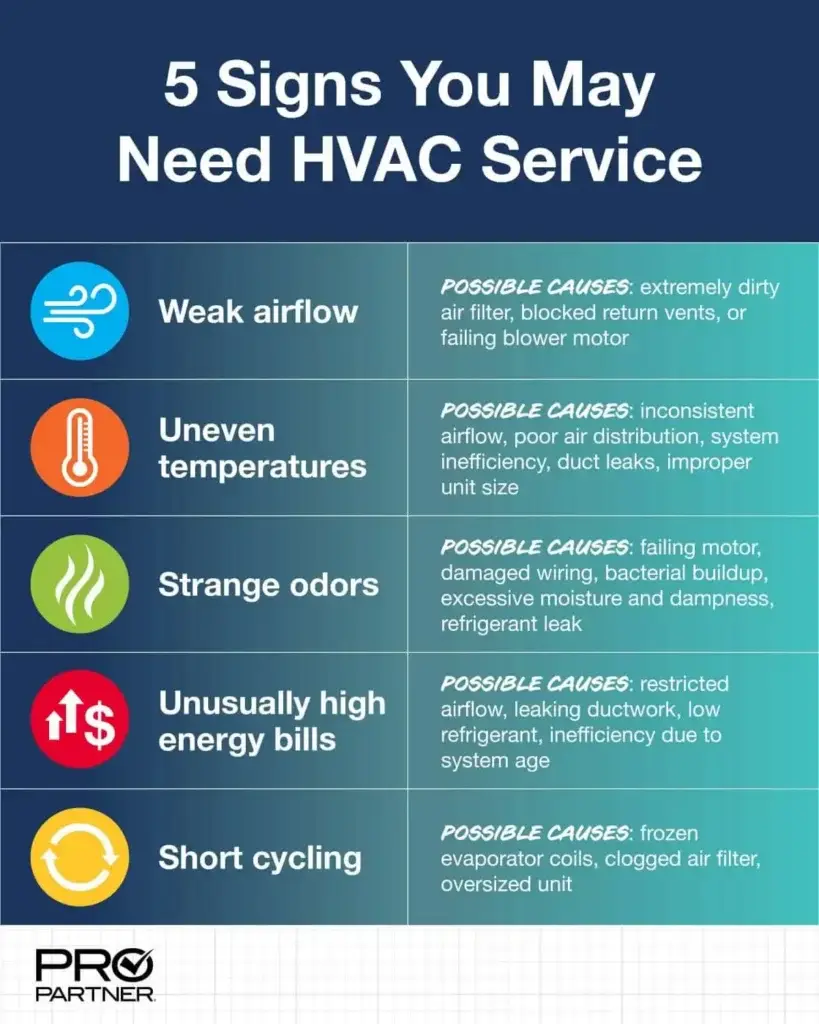
Sign 1: Weak Airflow From Your Vents
You notice the air coming out of your vents feels sluggish. The system is running, but the room isn’t reaching the set temperature the way it used to. That’s a problem worth investigating.
Weak airflow usually points to one of three culprits: an extremely dirty air filter, blocked return vents, or a failing blower motor. A clogged filter restricts airflow, which forces your blower motor to work harder and draw more electricity. Blocked return vents create the same strain. A failing motor means your system simply can’t move air the way it should.
Left alone, each of these issues compounds. Your system runs longer to compensate, your energy bills rise, and components wear out faster than they should.
When inspecting an airflow complaint, we don’t guess. We trace the problem to its source, whether that’s a filter replacement, a vent obstruction, or a motor diagnosis and repair it correctly the first time.
Sign 2: Uneven Temperatures Throughout Your Home
One room is comfortable. Another is stuffy or cold. You adjust the thermostat, and nothing really changes.
Uneven temperatures usually signal a distribution problem somewhere in the system. The causes can range from duct leaks and poor air distribution to an improperly sized unit or a system that’s lost efficiency over time. An oversized unit, for example, cools or heats too quickly without running long enough to distribute air evenly throughout your home.
Beyond the discomfort, uneven temperatures mean your system is working inefficiently. That inefficiency shows up on your energy bill every month.
We will run full system diagnostics to identify where the distribution is breaking down. From there, we calibrate, repair, or optimize the system so your entire space reaches and holds the right temperature.
Sign 3: Strange Odors Coming From Your HVAC System
A burning smell. A musty odor. Something that reminds you of chemicals. None of these are normal, and none of them should be ignored.
Each odor points to a different underlying problem. A burning smell often indicates a failing motor or damaged wiring. Musty odors typically signal bacterial buildup or excessive moisture somewhere in the system. A chemical smell can point to a refrigerant leak, which affects both your system’s performance and your indoor air quality.
These aren’t cosmetic issues. Refrigerant leaks and electrical faults are safety concerns. Bacterial growth circulates through your air every time the system runs.
It is important to identify the source of odors accurately and resolve them directly. We don’t mask symptoms, we find what’s causing them and fix it.
Sign 4: Unusually High Energy Bills
Your usage hasn’t changed much, but your energy bill has climbed noticeably. That’s a common complaint, and it almost always points back to the HVAC system.
Restricted airflow, leaking ductwork, low refrigerant levels, and an aging system are the most frequent causes. When your system can’t run efficiently because it’s fighting a clog, losing refrigerant, or compensating for leaky ducts it draws more electricity to produce the same result. You pay the difference every billing cycle.
The environmental cost matters too. An inefficient system uses more energy than necessary to maintain your comfort, which adds up over time in ways beyond your monthly bill.
Efficiency audits to identifies exactly where your system is losing performance. Proactive maintenance: cleaning coils, sealing ducts, checking refrigerant levels often brings energy costs back down significantly.
Sign 5: Short Cycling
(Your System Turns On and Off Too Frequently)
Your HVAC unit kicks on, runs briefly, shuts off, then starts again a few minutes later. This pattern, called short cycling, puts serious strain on your system.
Short cycling can be caused by frozen evaporator coils, a clogged air filter, or an oversized unit that heats or cools a space too quickly and shuts down before completing a full cycle. Each start-up cycle puts stress on your compressor and electrical components. The more frequently your system short cycles, the faster it wears down.
A system that short cycles won’t last as long as one that runs in proper, complete cycles. And the underlying causes frozen coils, a chronic airflow restriction, or a sizing mismatch won’t resolve themselves.
Diagnosing the exact cause of short cycling and makes the appropriate repair. If the issue is a sizing mismatch, we’ll tell you that directly and explain your options honestly.
Why Choose Robaire Company for HVAC Service?
At Robaire Company we bring hands-on expertise to every service call. We’ve worked on a wide range of HVAC systems, which means we recognize problems quickly and fix them accurately. We don’t recommend repairs you don’t need, and we don’t sell you a replacement when a repair will do the job.
Our commitment is straightforward: diagnose correctly, communicate clearly, and fix it right. Every customer gets a thorough explanation of what we found and what we’re doing about it.
We also offer preventative maintenance plans, because the best HVAC service call is the one you don’t need to make urgently. Routine inspections catch small issues before they become expensive failures and they keep your system running efficiently year-round.
Don't Wait Until Your HVAC System Breaks Down
The five signs above: weak airflow, uneven temperatures, strange odors, high energy bills, and short cycling are your system’s way of telling you something is wrong. The earlier you respond, the less it costs to fix.
A little attention now goes a long way toward keeping your home comfortable and your energy bills predictable. Contact Robaire Company today to schedule a professional HVAC inspection. We’ll give you a straight assessment of where your system stands and what it needs.

Frequently Asked Questions
How do I know if my HVAC system needs repair or full replacement?
Age and repair history are the two biggest factors. If your system is under 10 years old and hasn’t needed repeated repairs, a targeted fix is usually the right call. If it’s older and experiencing multiple issues at once, replacement may be more cost-effective long-term. Robaire Company will give you an honest assessment either way.
How often should I schedule HVAC maintenance?
Most HVAC systems benefit from professional service once a year, ideally before the season when you’ll rely on the system most. If you use both heating and cooling heavily, twice-yearly maintenance is worth considering.
Can a dirty air filter really cause that many HVAC problems?
Yes. A clogged filter restricts airflow throughout the entire system. That single restriction can cause weak airflow, short cycling, frozen coils, and higher energy bills. Checking and replacing your filter regularly is one of the most effective things you can do between professional service visits.
What causes an HVAC system to short cycle?
Short cycling most often results from frozen evaporator coils, a severely clogged air filter, or an oversized unit. Each cause requires a different fix, so accurate diagnosis matters. Running your system while it’s short cycling accelerates wear on the compressor and electrical components.
Is a strange smell from my HVAC system a safety concern?
It can be. Burning smells may indicate an electrical issue or a failing motor. Chemical odors can signal a refrigerant leak. Both warrant a professional inspection promptly. Musty odors usually indicate moisture or bacterial buildup, which affects indoor air quality. Don’t run the system until the source has been identified.
Schedule an Appointment
Contact Robaire Company, Inc.
We offer 24/7 Emergency Service to all of our customers. We also understand the importance of being safe and comfortable in your home. Robaire Company, Inc. is a certified Rheem ProPartner. We are licensed and insured in PA, NJ and DE. Please ask for references. Your comfort… It’s that important!